Free Shipping for orders over €200!
Drone pilot hat and patch – visibility, safety & regulations
A Drone Pilot Hat would have helped me! – I got stopped by security three times in my first month of flying commercially. Three times. Same story each time: some guy with a high-vis vest walking over asking who’s flying the drone, whether I have permission, and if I could show my license.
After the third time, I started wearing a cap with “drone pilot” embroidered on it. Sounds simple, almost too simple. But the difference was immediate. People could see who was responsible for the aircraft in the sky. Security guards nodded instead of approaching. Dog walkers gave me a wave instead of a worried look, all thanks to my drone pilot hat.
That’s the thing nobody tells you when you get your drone license. You need to be visible. Not just for regulations, but because it makes every single flight smoother.
The visibility problem most drone pilots ignore
Here’s what typically happens when you fly in a public space without any identification. You set up your DJI Mini or Mavic, launch from a quiet corner, and start shooting. Within five minutes, someone nearby notices a buzzing sound overhead. They look around, trying to figure out who’s controlling it. They can’t tell. So they either get nervous, call someone, or walk over and interrupt your session.
This happens less in remote areas, obviously. But if you fly anywhere near people (parks, beaches, events, construction sites, real estate properties), you’re going to deal with it regularly.
A drone pilot hat solves the problem before it starts. It’s visible from 20 metres away. Anyone who spots the drone overhead can immediately identify who’s responsible just by scanning the area for the person wearing the cap.
What the rules actually say about pilot visibility
No aviation authority requires you to wear a specific uniform. Let’s get that out of the way. But several do require that you’re identifiable and locatable during flight operations.
In Europe, EASA regulations state that the remote pilot must be identifiable. If you’re flying in the open category (A1/A2/A3), you need your operator registration number displayed on the drone, and you need to be findable as the person in command. Wearing a branded drone pilot cap with your operator number on it is one of the easiest ways to tick this box.
In the US, FAA Part 107 requires the remote pilot in command to be directly participating in and able to respond to operation queries. While there’s no dress code, being visually identifiable means authorities don’t waste time figuring out who’s in charge.
In the UK, the CAA’s drone code recommends making people in the area aware that you’re flying. A hat or patch that clearly says “drone pilot” does this passively without you having to approach every person within 50 metres.
The point isn’t that you’ll get fined without a drone pilot hat. The point is that visible identification removes friction before it starts.
What to look for in a good drone pilot hat
Not all hats work equally well for flying. After burning through a few cheap ones from Amazon that faded after two washes, I started paying attention to what actually lasts.
You want something breathable, because you’re standing outdoors for hours. You want the embroidery to be durable, not a printed transfer that peels. You want an adjustable fit because you might be wearing it over sunglasses or a headband. And you want it to look decent enough that you’d wear it to a client meeting, not just a solo flight in a field.
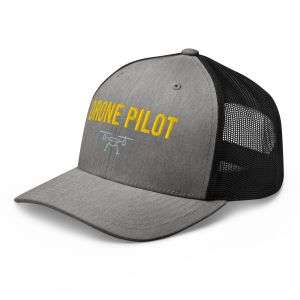
The professional drone pilot cap with distressed brim ticks all of these. It’s 100% cotton twill, embroidered (not printed), and the distressed look means it doesn’t scream “brand new costume.” It just looks like a hat you’ve been wearing for ages. The adjustable hook and loop closure means one size actually fits everyone, which matters if you’re buying it as a gift too.
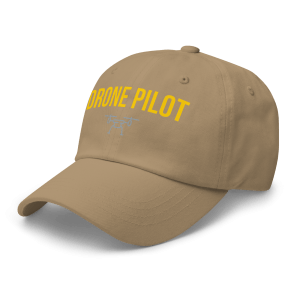
For summer sessions, a mesh-back cap makes a big difference. The drone pilot summer hat has ventilation panels that stop your head from overheating during those two-hour golden hour sessions when you don’t want to stop shooting.
If you fly in winter (and you should, the footage is gorgeous when there’s frost or low mist), a thermal drone beanie keeps your head warm without bulking up around your ears so much that you can’t hear your aircraft. Cold ears end sessions early. A good beanie adds an extra 30-40 minutes to your winter flights.
For all-round sun protection, the organic bucket hat covers the back of your neck too. I use one when I’m doing long mapping sessions and I’m staring at the screen for extended periods. The wider brim of that drone pilot hat stops that sunburn stripe you get on the back of your neck from a standard cap.
Why patches still matter in 2026
Patches have been part of aviation culture since the early days of military flying. Pilots wore them to identify their squadron, their rank, their speciality. That tradition carried over to commercial aviation and now it’s found its way into the drone world.
A drone pilot patch is useful in situations where you’re wearing a jacket or vest that covers your hat. On cold days, your cap might be hidden under a hood. But a patch on your chest or arm is still visible.
It also adds credibility in commercial settings. When I turn up to a real estate shoot wearing a vest with a UAS pilot patch on it, estate agents don’t question whether I know what I’m doing. It’s a small thing, but first impressions happen fast, and looking like a professional from the moment you arrive means you spend less time justifying your presence and more time flying. A drone pilot hat is a must in these situations.
For more casual use, drone pilot pin buttons work well on a camera strap or crossbody bag. They’re subtle enough for everyday wear but still signal to other drone enthusiasts that you’re part of the community, get a drone pilot hat or a drone pilot patch!
Putting together a basic identification kit
If you’re flying commercially or in public spaces regularly, here’s what I’d recommend as a minimum:
For warm months: a breathable drone pilot hat (summer cap or the distressed cap) plus a drone pilot patch on your camera bag or vest.
For cold months: the thermal beanie for warmth, with a patch clearly visible on your outer layer since the hat won’t have branding.
For client work: the professional cap paired with a polo or clean t-shirt, UAS patch on a vest or jacket pocket, and your operator documents in a cross bag so you look organised when you arrive.
It’s not about spending a fortune. A cap and a patch together run about €30. That’s less than a single battery, and you’ll use them on every flight for years.
The community benefit nobody talks about
There’s a bigger picture here too. Every time a member of the public sees someone flying a drone while clearly identified as a licensed pilot, it normalises the hobby. It shows that drone pilots are responsible, identifiable people who take safety seriously. Wear your drone pilot hat to make everyone at ease.
The more of us who look professional out there, the less resistance the entire community faces. Local councils, park authorities, property managers – they’re all more likely to allow drone operations when their past experiences involved professional-looking operators rather than anonymous figures launching from car parks.
Your drone pilot hat and patch aren’t just personal gear. They’re a small contribution to how the public perceives all drone pilots. And right now, with regulations still tightening across Europe and the US, that perception matters more than ever.
Browse the full hats and headwear range | See all patches and pins
You might also like: